Part 1: Khairpur Mirs. The Talpur dynasty and Azadari in Sindh
Anwar Rizvi
It was a scorching hot summer’s day on the 6th of June, 1963. It was the day of Ashura, the 10th of Muharram ul Haram. The Shia of the village of Therhi in the district of Khairpur, just like their fellow Shia all over the world, were preparing to bring out their traditional Taazia procession. Emotions were running high in the village. They always do at this time of the year. But this year there was added tension. Villagers had been receiving threats from a nearby Madressah about not bringing out the Taazia on the road as it was considered biddah in their eyes and avoiding a certain route for the procession as it went past the Madressah. The villagers were having none of it. This was Khairpur after all. Azadari ran through people’s veins. It was in their DNA. They were not willing to compromise. A clear message was sent back to the Madressah: the Taazia will be coming out and the route will not be changed. What followed was one of the worst single incidents of Shia killings on record. A mob of thousands armed with axes, swords, machetes and knives attacked the procession. Over 160 were hacked to death in cold blood as the local police stood by and did nothing to stop the killers. The incident was completely covered up by the authorities and press were ordered not to mention the incident in any great detail. Although a report was published later that year, it did not mention any names and avoided blaming any particular group. To this day, the families of the victims of the Therhi massacre await justice. But why did a tragedy like this happen in Khairpur, a usually sleepy backwater of Northern Sindh where Azadari in its present form had been going on quite peacefully for at least 300 years and relations between various communities had always been very cordial? Muharram after all was for everyone. In fact the entire province of Sindh is quite unique in the sense that the traditions of Muharram are respected and in fact revered by all communities, including non Muslims, and sectarian tensions are still a relatively rare occurrence with the exception of Karachi.
Origins of Azadari in Sindh can be traced back to the 6th century AD when the then ruler of Sindh, the Raja Dahir gave sanctuary to the descendants of the Ahlulbayt (AS) who were fleeing from the oppression of the Ummayads. Raja Dahir’s defeat at the hands of the Ummayad general Muhammad bin Qasem and the subsequent conquest of Sindh by the Ummayads resulted in another prolonged period of oppression of the Syeds and their followers and it is very likely that most were either killed, taken prisoner or sought refuge in other parts of India beyond the reach of the Ummayad armies. However the influence of the Syeds remained through the many Sufi saints that had attracted large numbers of devotees both Muslims and non Muslims alike and despite the many harsh measures taken by the Ummayads to suppress and wipe out any form of devotion to the Ahlulbayt (AS), the seeds of love had taken root firmly and the saints became more revered and respected over the centuries than the Ummayad conquerors. This influence manifested itself in many forms and when the Kalhora king Mian Ghulam Shah Kalhoro decided to relocate his capital from the historical capital of Sindh, Khudabad to the more eastern banks of the river Indus due to constant flooding of the former capital, they were advised by the devotees of the Ahlulbayt (AS) to name the city after Imam Ali (AS). And so the new capital of Sindh became known as Hyderabad or the Land of the Lion, one of Imam Ali’s many names. It is said that this particularly pleased the then Shah of Iran who gifted the Kalhoras with an imprint of Imam Ali’s feet and it became and remains a place of pilgrimage to this day for tens of thousands of people, known as Qadamgah Maula Ali sharif.
It was not until the rise of the staunchly Shia Talpur dynasty that Azadari firmly took root and flourished once again not just in Sindh but across the border in Southern Punjab and parts of Baluchistan. The Talpurs are believed to be of Persian origin and first arrived in Sindh with the armies of Nader Shah Durrani where they settled on the borders of Northern Sindh and Baluchistan. Having assimilated well in the region and formed their own sub clan, they allied with the local tribes to rebel against and ultimately defeat the Kulhoras at the battle of Halani in 1783, thereby becoming the undisputed rulers of most of Sindh, The Talpurs ruled through a system called “Chauyari” meaning four friends. Sindh was effectively divided into 4 administrative regions with Mir Fateh Ali Khan as the first principal ruler. The Talpur kings called themselves Mirs and the state of Khairpur was known for many decades as Khairpur Mir’s or Khairpur Mirus in local slang. The Talpurs were passionate about Azadari and under their rule the traditions of Aza flourished and prospered. Yet despite their own firm beliefs, they promoted a culture of tolerance and Sindh remained for the most part a region where people of all sects and faiths lived in peace and harmony with coercion and conversions almost unheard of. It was perhaps this culture of tolerance that further increased the love of the Ahlulbayt (AS) among the local populace and Muharram rituals became as much part and parcel of non Shia as they did of the Shia themselves. Ya Ali Madad became the most common form of greeting among people and to a large extent remains so to date.
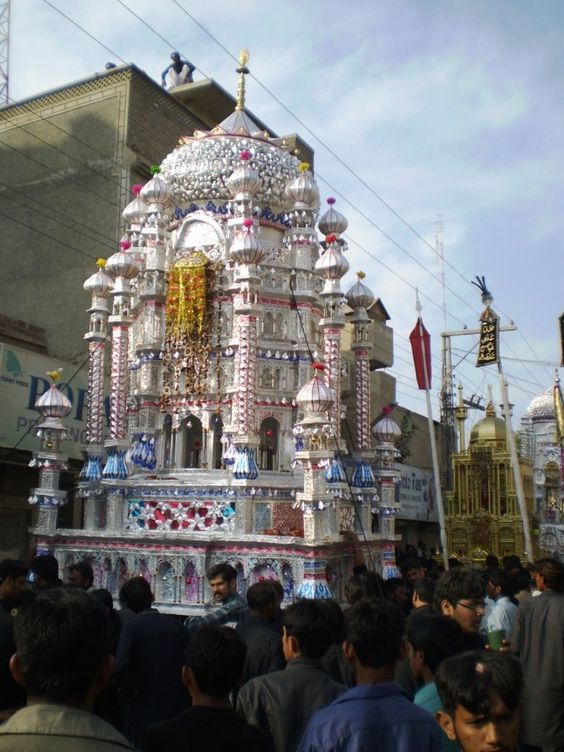
The Talpurs would eventually be defeated by the British and General Charles Napier through the usual mixture of deceit and division and unilateral abrogation of treaties with the Talpurs. The Mirs were imprisoned and exiled to Calcutta. Their homes and palaces were looted and even the ladies of the household were not spared as they were relieved of all their jewellery and valuables. The Khairpur branch of the Talpurs was to survive only by virtually signing a treaty of accession to the Biritish. Despite the tragic ending of their rule, the Talpurs had already left an indelible mark on the traidtions of Aza, The skyline of the capital Hyderabad was dotted by Alams of various sizes and colours, and Muharram processions came out in full pomp and glory with everyone participating regardless of faith. The Talpurs would gather in Hyderabad for Ashura where they would lead the main procession and money was distributed to various localities for people to cook food and break their “faqa” at the end of the procession. Mir Fateh Ali Talpur, the first Mir asked his chief of staff Faqir Muhammad Junejo to have a Taazia built as a replica of the the Zareeh of Imam Hussain (AS). It was kept in the Imabargah in Peshori Mohalla which also became known as Faqir Jo Pir after Faqir Muhammad Junesjo. When the deposed Mir Hasan Talpur returned from exile in Calcutta, he gave the Taazia to Mirza Fateh Baig who was the mutwalli of the historic Aliabad Imambargah in Tando Agha, The Taazia is still kept in Aliabad Imambargah and is probably the oldest known Taazia made in this part of the sub continent. The Talpurs built other Shabeeh e Mubarak at Tando Noor Muhammad and Tando Mir Muhammad and these survive in very good condition to this day. Similar shabeehs on a smaller scale were built in other towns and villages across Sindh. The purpose of building these Shabeehs and Zareehs was to give those who could not afford the pilgrimage to the holy places to feel closer to the Ahlulbayt (AS) and to observe the rituals of mourning as close to their localities as possible. The Talpurs also constructed a prayer hall and Imambargah around the Qadamgah Maula Ali (AS) to allow greater access and open pilgrimage to the general public. Today the Qadamgah sharif attracts tens of thousands of devotees, Shia, Sunni, Hindus and Christians from all over Pakistan, as well as India, Afghanistan and many other countries. For many years during the Talpur rule, the ladies of the Talpur family would visit during Thursday nights after Maghreb and a special room was reserved for them to spend time in prayers and offer their respects. It is also at this very place that many prominent poets during the Takpur dynasty composed some of their most acclaimed poetry on the Ahlulbayt (AS) in Sindhi, Urdu and Farsi and this tradition in fact continued during the British occupation.
As the British rule entrenched across Sindh and the entire sub continent, Khairpur under the last surviving Talpur Mirs replaced Hyderabad as the epicentre of Aza. As in Hyderabad, the Talpurs continued with their devotion to Azadari and the city and state of Khairpur attracted lovers of the Ahlulbayt (AS) from all over the sub continent. Official patronisation of Muharram processions and the construction of Imambargahs, Zareehs and Shabeehs in almost every locality of Khairpur continued under the various Mirs that ruled Khairpur under the British until independence and partition in 1947. Khairpur was given Princely state status within the Dominion of Pakistan as it then was. And within that framework the Mir of Khairpur had limited autonomy to run the affairs of his state. However the agreement was never implemented fully in letter and spirit and the Mir found himself increasingly at odds with the Pakistani government. Things really came to a head after the assasination of Liaquat Ali Khan. The succeeding adminstrations further curtailed the powers of the last Mir George Ali Murad Khan and the writing for the Talpur dynasty was pretty much on the wall. Despite his travails as now a ruler in all but name, Mir Ali Murad did what his ancestors had done for centuries. He did not allow his substantially reduced powers to compromise on his passion for Aza and his devotion to the Ahlulbayt (AS). In the 1950s Mir Murad Ali sent 2 masons to Kerbala to closely study the design of the shrine of Imam Hussain (AS). He wanted to build an exact replica of the shrine in Khairpur. The masons spent almost 6 months in Karbala and upon return they built a Shabeeh of the holy shrine which is remarkably similar to the original. One of Mir Murad Ali’s ancestors had a similar Shabeeh built at Kot Diji, effectively the second capital of Khairpur state, but as it’s built on private property it remains open to members of the Talpur family only.
In 1955, as Pakistan was slowly working through one constitutional crisis after another in her quest to become a fully independent republic. the State of Khairpur was formally annexed into Pakistan and thus ended the rule of the Talpur dynasty after almost 300 years. Despite the ending of the Talpur rule, the traditions of Aza remain alive, well and thriving in the city of Khairpur and the environs. Mir George Ali Murad Khan, now in his 90s, still holds a public Majlis at Faiz Palace, his ancestral abode. As an interesting aside, Mir Ali Murad took the daughter of the renowned scholar and orator marhum Allama Rashid Turabi (RA) as his second wife. His first wife was the daughter of the last Nawab of Bahawalpur.
Which brings us to that fateful afternoon in village of Thehri in June 1963. While the tragedy was completely covered up by the authorities and no culprits have ever been named. Was there an element of vindictiveness by some extremists who held a grudge against Azadari being given such prominence by the state itself during the Talpur era? Would the tragedy have occurred if Khairpur’s status had not been changed. as tolerance had been the hallmark of the Talpur rule.? Quite clearly this was an attempt to create sectarian disharmony and instill fear among people, in an attempt to stop Muharram rituals from taking place. It didn’t work, The murderers may have got away with their crime, but they failed in their attempt to extinguish the flame of eternal love.
Labbayk Ya Hussain!
 Rizvirambles
2 responses to “Keeping the eternal flame alive: History of Aza in the Sub Continent”
Excellent read!! Loved it!! Can’t wait for more.
LikeLike
Thank you 🙂
LikeLike